Summary
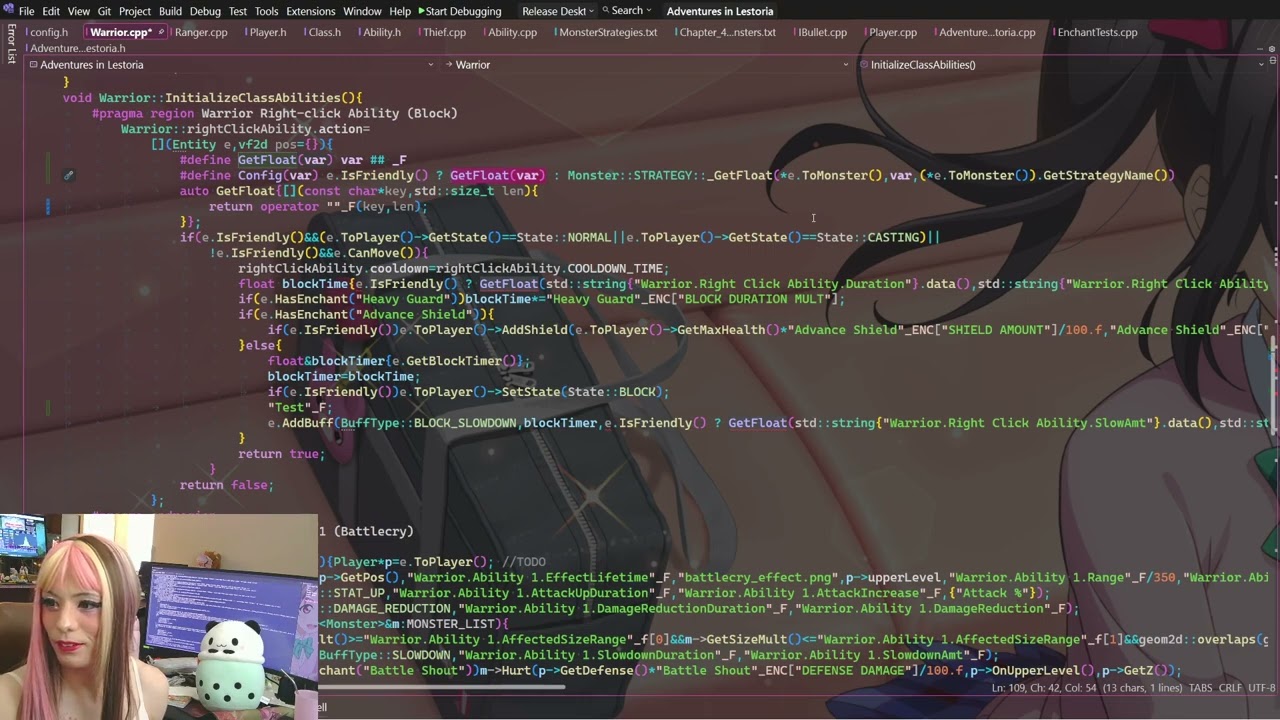
TL;DR: The streamer tackles a mysterious MSVC‑only compiler error by creating wrapper macros and a custom entity‑handling system, then revamps the config‑file parser to correctly handle dot‑separated keys, while wrestling with long compile times.
Verdict: WATCH — the deep dive into macro tricks, debugging tactics, and architectural redesign offers solid learning for C++ game developers.
Key Takeaways
- The original issue was a MSVC‑specific parsing error that didn’t appear in GCC/Clang, forcing a workaround rather than a fix.
- A wrapper macro (
get_bloat) was designed to prepend “_f” to identifiers, avoiding the problematic syntax. - The discussion covered token‑pasting (
##) vs. string‑concatenation in macros, revealing limitations of the pre‑processor for this case. - A lambda‑based “for player/monster” macro was prototyped to simplify repeated “if friendly then …” blocks.
- The config system’s
get_propertywas re‑engineered to first check for an exact key (including dots) before drilling into nested objects. - Debugging exposed long compile times (≈4 min), leading the author to question C++’s suitability for rapid iteration.
- The session ended with a successful commit that supports both dotted and non‑dotted property access, and a plan for further testing.
Insights
- Compiler‑specific quirks can mandate architectural shifts – the MSVC error led to a macro‑based abstraction that benefits all compilers.
- Token‑pasting (
##) can’t replace whitespace‑sensitive operators; the need for exact token adjacency forced a redesign of the macro strategy. - Prioritizing full‑key lookup before recursion dramatically simplifies property resolution and avoids accidental drilling into non‑existent objects.
- Build‑time latency becomes a design constraint; the author’s contemplation of alternative languages underscores the hidden cost of large C++ codebases.
Key Topics
- MSVC compiler parsing bug
- Macro design & token‑pasting
- Lambda/macros for entity handling
- Config file property parsing (dot notation)
- Debugging workflow & compile‑time considerations
Key Moments
0:00 - Introduction and discovery of the MSVC‑only compiler error.
5:00 - Exploration of token‑pasting (##) and why it can’t solve the string‑concatenation issue.
12:00 - Prototype of a lambda‑based macro to unify player and monster actions.
28:00 - First major debugging of the get_property function and the dot‑handling problem.
45:00 - Reflection on long compile times and their impact on development workflow.
62:00 - Deep dive into the interface.vignette_color property recursion and breakpoint analysis.
78:00 - Final resolution of dot‑key handling, commit summary, and next steps.
Notable Quotes
"The pain of waiting four minutes to compile reminds me that iteration speed is a huge friction point for game development."
Best For
C++ game developers and programmers who work with complex macro systems and need robust strategies for handling configuration data.
Action Items
- Implement the
get_bloatwrapper macro (or similar) across the codebase. - Update
get_propertyto check for exact key matches before recursive drilling. - Run a full rebuild to verify the new property parsing works for both players and monsters.
- Log compile times and evaluate build‑system optimizations or alternative languages for future projects.