Summary
TL;DR: A live mock Go interview where Andrey solves string, map, and concurrency questions, followed by an overview of the Shortcat mentorship program.
Verdict: WATCH — the session offers solid Go concepts, real‑time problem solving, and useful insights into preparing for technical interviews.
Key Takeaways
- Strings in Go are immutable; to modify characters you must work with byte slices or create a new string.
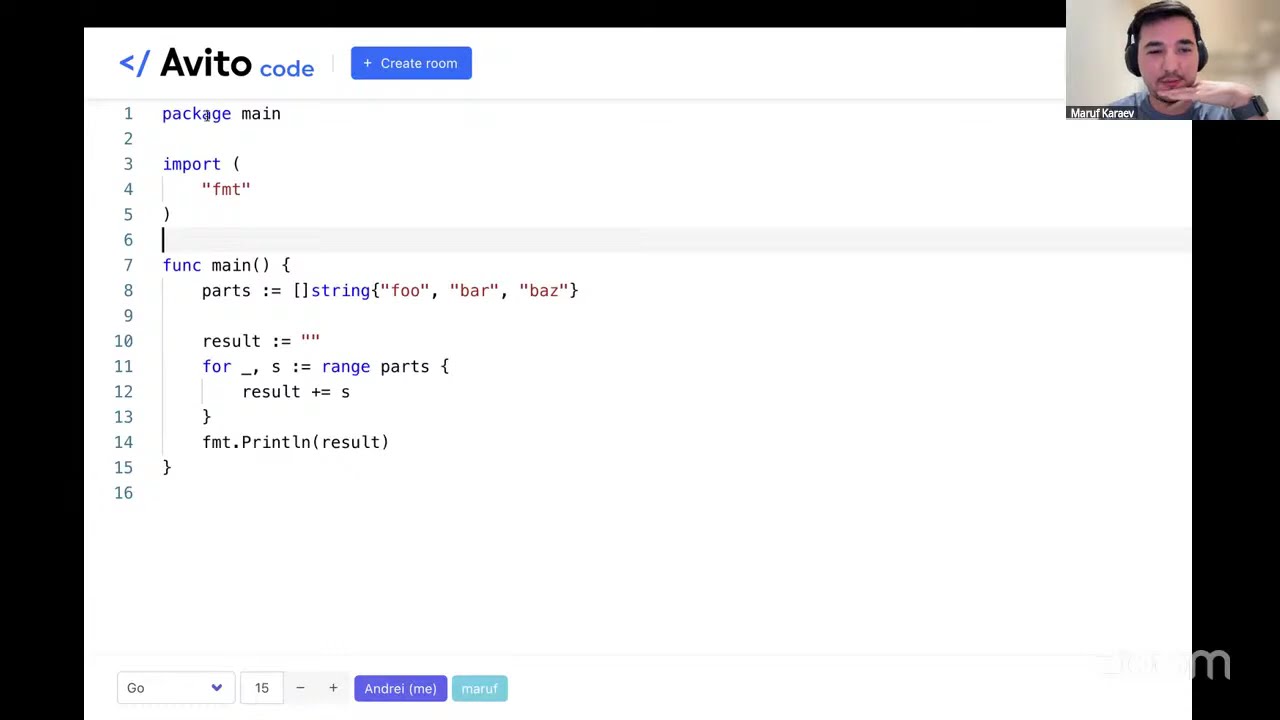
- Repeated string concatenation with
+creates new allocations; usingstrings.Builderyields O(N) memory usage instead of O(N²). - Go 1.24 changed map internals from closed addressing to open addressing with SIMD‑accelerated bucket probing, improving lookup speed.
- Only comparable types can be map keys (no slices, maps, functions). Interface equality depends on both dynamic type and value.
- Implementing a basic mutex with a buffered channel works, but handling readers‑writer semantics (RWMutex) requires tracking active readers, often via additional channels or counters.
- The Shortcat program conducts paid mock interviews, provides detailed feedback, guarantees five real interviews, and offers a money‑back guarantee.
- Audience voted Andrey’s skill level as “mid‑level” (40% of votes).
- Current Go job market is competitive; strong resumes, referrals, and targeted interview practice remain essential.
Insights
- Go 1.24’s map redesign leverages CPU SIMD instructions to check all eight slots of a bucket in a single cycle, a subtle but powerful performance boost.
- Even though Go strings are UTF‑8, the length in bytes isn’t reliable for character count; converting to a rune slice yields the true character count.
- Using a buffered channel of size 1 as a lock can simulate a mutex without the
syncpackage, but scaling to RWMutex logic quickly becomes complex. - The mentorship service’s guarantee of five interview opportunities is a rare market differentiator, reducing risk for candidates.
Key Topics
- Go string immutability and byte vs rune handling
- Memory impact of string concatenation and
strings.Builder - Internal changes to Go maps in version 1.24
- Comparable types and interface equality in Go
- Custom synchronization primitives with channels
- Overview of the Shortcat mock‑interview & mentorship program
Key Moments
- 0:45 – Introductions: Maruf and Andrey share their Go experience.
- 4:10 – Discussion on mutating strings and byte vs rune length.
- 6:30 – Memory cost of repeated string concatenation;
strings.Buildersuggestion. - 9:15 – Deep dive into Go 1.24 map implementation (open addressing, SIMD).
- 12:00 – Which types are comparable and can be map keys.
- 15:45 – Implementing a simple mutex with a buffered channel.
- 22:20 – Presentation of Shortcat’s mock interview service and guarantees.
Notable Quotes
“In Go 1.24 maps switched to open addressing with SIMD‑enabled bucket probing, letting the CPU compare eight slots in a single instruction.”
Best For
Developers preparing for Go technical interviews and anyone considering a structured mock‑interview mentorship.
Action Items
- Review Go’s string handling: practice converting between strings, byte slices, and rune slices.
- Refactor any
+string concatenations to usestrings.Builderfor better performance. - Experiment with a channel‑based mutex and, if needed, extend it to an RWMutex using reader counters.
- Explore Shortcat’s mock interview offering if you need personalized feedback and interview guarantees.