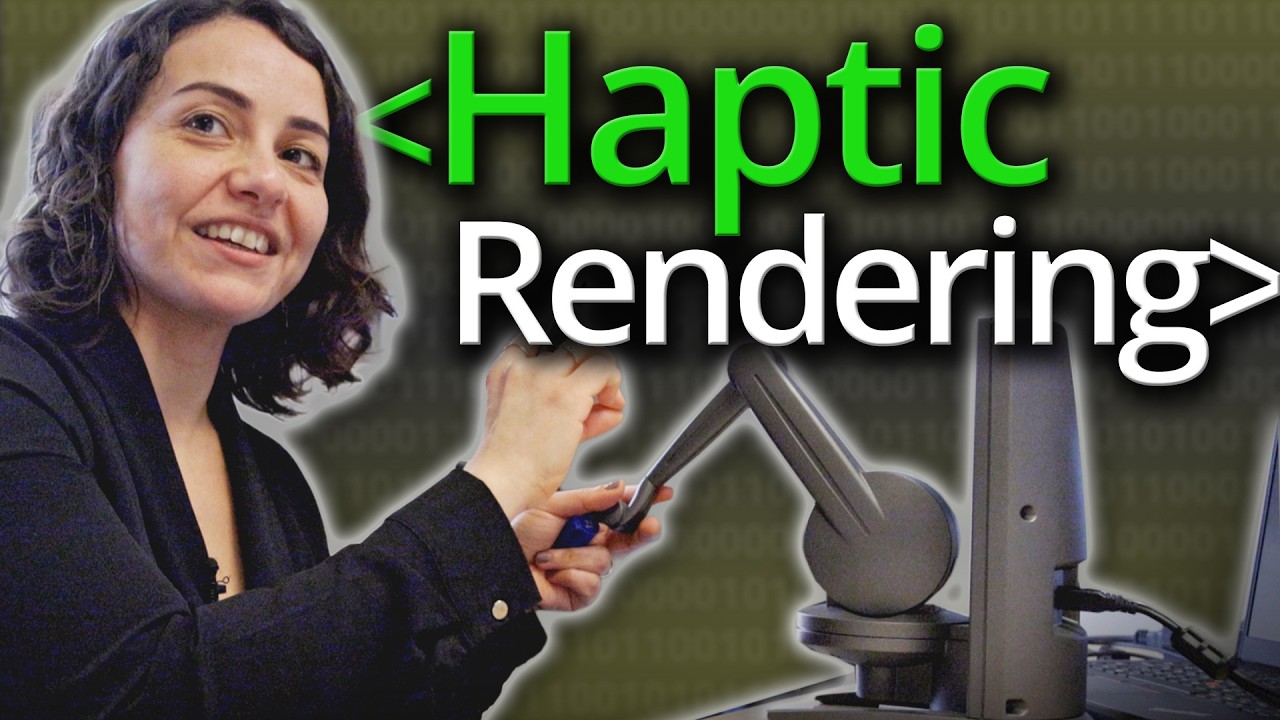
📊 Video Analysis
Usefulness: 7/10 · Water%: 30% · Density: medium
🎯 What You'll Learn
- How forward and inverse kinematics are used to compute tool‑tip positions and motor torques in a haptic device.
- How collision detection and response are performed for haptic rendering (bounding‑volume hierarchies, proxy/god‑object algorithm).
- Why haptic loops must run at ≈1 kHz and how stability problems (popping, bouncing) are mitigated.
📋 Key Topics
- Types of haptic feedback (cutaneous vs. kinesthetic)
- Haptic rendering pipeline (visual loop vs. haptic loop)
- Proxy (god‑object) algorithms for stable force feedback
👥 Best For
Robotics, VR/AR, and computer‑graphics engineers or students who need a practical overview of real‑time haptic rendering.
💧 Water Content: 30%
The talk is mostly technical, but it includes a fair amount of introductory chatter and analogies that could be skimmed.
⏱️ Time Worth
Worth watching the full video for a solid conceptual foundation; you can skip to ~2:10 for the kinematics explanation, ~5:30 for collision detection, and ~11:00 for the proxy algorithm if you’re short on time.
✅ Verdict: WATCH
The video gives a clear, example‑driven walk‑through of the core problems in computer haptics and offers concrete techniques (bounding‑box hierarchies, proxy rendering) that are directly usable in projects. While some filler is present, the depth of explanation justifies a full watch for anyone building or studying haptic interfaces.